
If you’re a busy professional (managers, executives, healthcare professionals, nurses, business owners, software developers, engineers), chances are – weight loss feels like one more thing on an already overwhelming day.
ack to back meetings, long commutes, traffic hours, skipped lunches, business socials, travel, and stress. By the end of the day, even making dinner can feel unrealistic.
For most people, losing weight is not just about the numbers. It’s to:
- Feel confident and feel great in your own skin again
- Move with ease and reduce joint pain
- Have more energy throughout the day
- Have a better relationship with food
- Reduce the mental burden and feel in control around food again
If you feel like you’ve tried everything but nothing has worked, you’re not alone.
There are ways to lose weight that work with your busy schedule.
As a dietitian and weight-loss coach, my goal is to help busy professionals start seeing results with evidence-based strategies that fit real life and your life.

Helen Tieu
Why Many Busy Professionals Feel Stuck
- No time for meal prep leads to: grab-and-go eating, Uber Eats, or eating out.
- Long work hours and stress can lead to: sugar cravings, overeating at night, and late-night snacking.
- Skipping meals during the work day can lead to: energy crashes and overeating later.
- Conflicting diet advice online or from others can lead to feeling overwhelmed on where to start with no actions or progress in sight.
- Food restrictions backfire for most people long-term, and can lead to: more cravings, overeating, guilt.
Sustainable weight loss is not :
meal prepping every Sunday, eating chicken, broccoli and rice for dinner everyday, eliminating all sugars, and/or spending hours at the gym. That does not sound fun at all!
Working with an experienced dietitian helps you cut through the noise and gain clarity. Instead of rigid rules, you’ll explore practical strategies tailored to your schedule, preferences, culture, and health needs.
A dietitian helps keep you accountable, problem-solve roadblocks and adjust along the way, and create a customized plan that feels supportive so progress is sustainable. Online calculators, influencers, and generic plans give you a number, not a strategy.
AI doesn’t know your day-to-day reality, your sleep schedules, stress levels, meal and snack patterns, how your body responds, or how to adjust your nutrition when progress stalls.
A personalized approach will actually save you time and money because it:
- Accounts for your schedule, preferences, stress, sleep, and medical history
- Uses flexible meal planning that works with travel, family life, and work demands
- Reduces inconsistency caused by unrealistic expectations
- Includes accountability, troubleshooting, and mindset support to help you stay on track when life gets busy or stressful
A weight loss dietitian can tell you what your needs are and take away the guesswork. You’ll gain lifelong knowledge that’s tailored to you and your lifestyle, and confidence in the process.
This is why we don’t just give meal plans. We teach you how to eat for life.
5 Smart Strategies for Busy Professionals
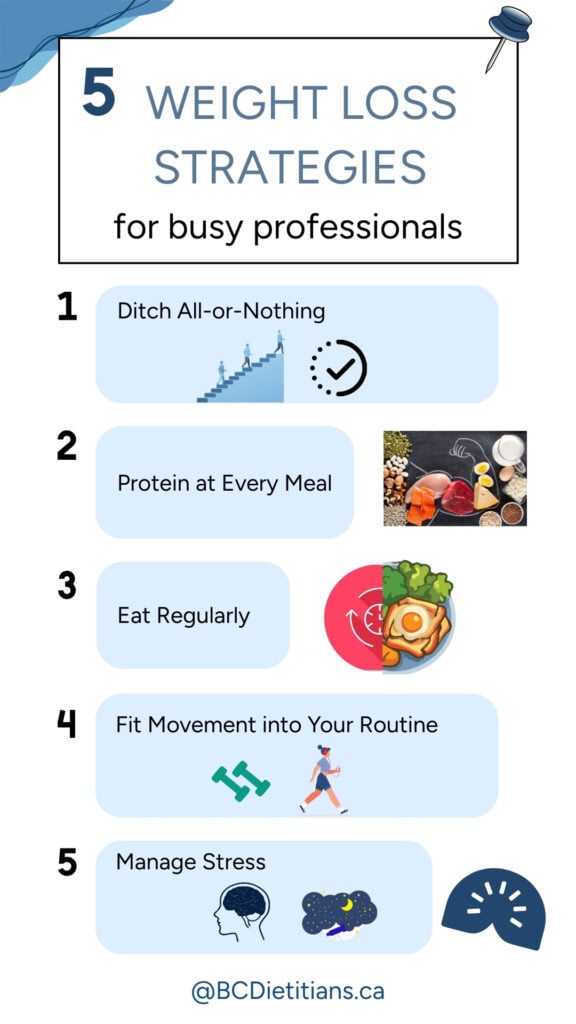
Backed by 102+ 5-stars google reviews working with hundreds of clients over the years. Here’s what I see work consistently with busy professionals.
1. Consistency beats intensity every time.
Pushing yourself to be strict with a meal plan, disciplined, and in control – only to feel exhausted, frustrated, and back at square a month later. Trying to be perfect can make things worse in the long-run. It can also create unrealistic expectations and disappointment down the road.
Instead of: “if I can’t workout for 60 minutes, it’s pointless”, or “I’ll start again next week because I ate a slice of pizza today”, try short repeatable habits you can maintain during busy weeks.
Even just 10 minutes of walking around the neighborhood will get you further than you were before. If you can strategically plan your workouts and nutrition in a way that feels good to you, it supports your goals.
Because, in the end, it’s about finding balance and building what works for you so you can maintain your weight loss sustainably.
Choose progress over perfection – real change happens when you show up and choose to keep going.
2. Prioritize protein at every meal.
Protein is one of the most powerful tools for weight loss because it:
- Keeps you full longer
- Helps preserve muscle
- Reduces mindless snacking
For busy professionals, this doesn’t mean complicated recipes or forcing yourself to eat a lot of meat. Try building meals around a protein source:
- Greek yogurt or protein smoothie for breakfast
- Rotisserie chicken, eggs, tofu, or canned fish for quick meals
- Protein-forward snacks (cottage cheese, protein bars, jerky)
3. Structure your eating.
When your day is packed, decision fatigue leads to skipped meals, reactive eating, and late-night overeating.
Here are a few helpful strategies to start:
- Eat at roughly consistent times
- Plan ahead: choose your favourite meals and rotate them
- Keep “emergency meals” at work or in the freezer
- Avoid skipping meals – this is a recipe for overeating later on!
When you’re too busy (or hate) to cook:
- Try quick one-pot meals
- Smart shortcuts: rotisserie chicken, pre-chopped or frozen veggies, frozen meals with balanced macros
- Meal prep doesn’t have to mean hours in the kitchen, you can batch-cook 2 items/week: protein + grain, then mix and match
- Consider adding in ready-to-eat meal kits to reduce burnout
- Learn how to navigate takeout and restaurant meals strategically while still meeting your goals
Convenience foods can absolutely fit into a healthy plan.
You don’t need variety every single day – you need reliable options that prevent hunger from controlling your choices.
3. Manage stress without relying on food.
High stress increases hunger, cravings, and emotional eating. Weight loss becomes much harder when stress is ignored. Food is many people’s go-to for stress management.
Simple, realistic tools:
- Protect sleep where possible (7-9 hours a day)
- Eat every 2-4 hours to avoid blood sugar crashes
- Build decompression into your day (even 5-10 minutes)
You don’t need to eliminate stress, but know some ways that you can help yourself relax when the pressure becomes overwhelming.
5. Start tracking
You don’t need to track every calories forever. But awareness is key, and it’s an excellent temporary learning and awareness tool.
Options I often recommend:
- Track your food intake without changing anything at first to see where you’re at (the app I recommend is Cronometer)
- Tracking meals consistently (not perfectly)
- Using weekly averages instead of daily weight fluctuations
These data should inform your decisions, and not be a source of punishment for yourself.
When every meal has to be “clean” or tracked, food can become less supportive and start to feel stressful. This makes consistency harder.
It’s not simply “just eat less and move more”. Unhealthy lifestyle habits and rigid restriction often backfires long-term.
Instead of skipping meals and cutting out all carbs/sugar/alcohol, aim to:
- Eat protein at every meal
- Add volume with fiber-rich fruits and vegetables
- Be mindful of liquid calories and “healthy” processed snacks (e.g., flavoured yogurts that are loaded with added sugar)
- Build systems, and not rely on motivation. Using scheduling and default meals can help reduce your mental load.
- Use anchor habits: 3-5 non-negotiables you stick to no matter how busy life gets (e.g., hydration, protein, step count).
The Power of a Personalized Plan
A well-designed weight loss plan should make your life easier, not harder.
If your weight-loss plan:
- Requires constant willpower
- Adds stress to your schedule
- Falls apart during busy weeks
…it may not the right plan for you!
The best approach is one you can follow during your most demanding seasons, not just when life is calm.
With our weight loss program, we focus on:
- Assessing habits, goals, mindset, and schedule
- Small habit stacking instead of massive overhauls
- Sustainability over short-term results
- Understanding that weight loss is not linear
- Non-scale wins
- Recognizing plateaus vs. normal fluctuations
Most people aren’t actually “stuck”, they just need the right adjustments. Working with a dietitian and having ongoing accountability makes the process easier.
Last but not least: stay patient on your weight loss journey. A dietitian can help you make sure you’re not just sailing, but sailing in the right direction.
You Don’t Need Another Diet - You Need a Strategy.
As a dietitian and weight-loss coach, I see this over and over: busy professionals don’t fail at weight loss because they lack discipline. They fail because they’re trying to follow plans designed for people with unlimited time.
You don’t need more motivation.
You need a strategy that fits your life.
If weight loss feels harder the busier you get, that’s not a personal flaw – it’s a sign your approach needs to be more realistic.
Consistency beats perfection, and sustainable weight loss is possible, even for the busiest people.
If you are ready to invest in yourself and in your health, then let’s connect.
Click here to book a free call with me to go over your goals and what you’re looking for assistance with!
FAQ from Weight Loss Clients:
Eating at night does not directly contribute to weight gain – total intake in a day matters more than timing. However, most people aren’t making the best nutritious choices at night time. Sometimes, eating at night might be a signal for irregular eating or inadequate energy intake during the day. If you are experiencing frequent or more extreme hunger during the night, you may want to dive deeper into your eating patterns with a dietitian.
It can be, if it fits your lifestyle. However, it is not a magic bullet and weight loss still has to do with total calorie intake. If it’s not planned carefully, you might put yourself at risk of undereating or nutrient deficiencies and not being able to sustain the diet and results long-term.
There’s so much that goes into the weight loss equation.
Working with a dietitian and a weight loss coach, you might need to: give your body time for the results to show as we’re often impatient, adjust intake, improve nutrition, reduce stress, switch up exercise/training, and/or improve sleep.
Don’t quit. Assess what’s not working and adjust.





Add a comment