
The other day I was on a walk with a friend. She mentioned, almost in passing, that she’d recently been diagnosed with kidney stones.
I listened. I kept my dietitian brain on the shelf and just walked beside her as she described what the last few months had looked like. Diagnosis from her family physician. Referral to a urologist — roughly a year’s wait. A female urologist? Three years.
No nutrition guidance at any point in the process. Just a diagnosis, a referral letter, and the open road of the internet.
I didn’t say much. But I was grieving a little on the inside. Because I have heard this story so many times.
Chantelle Greentree, RD
Kidney Stones Statistics in Canada
Let’s establish that we’re not talking about a rare condition.
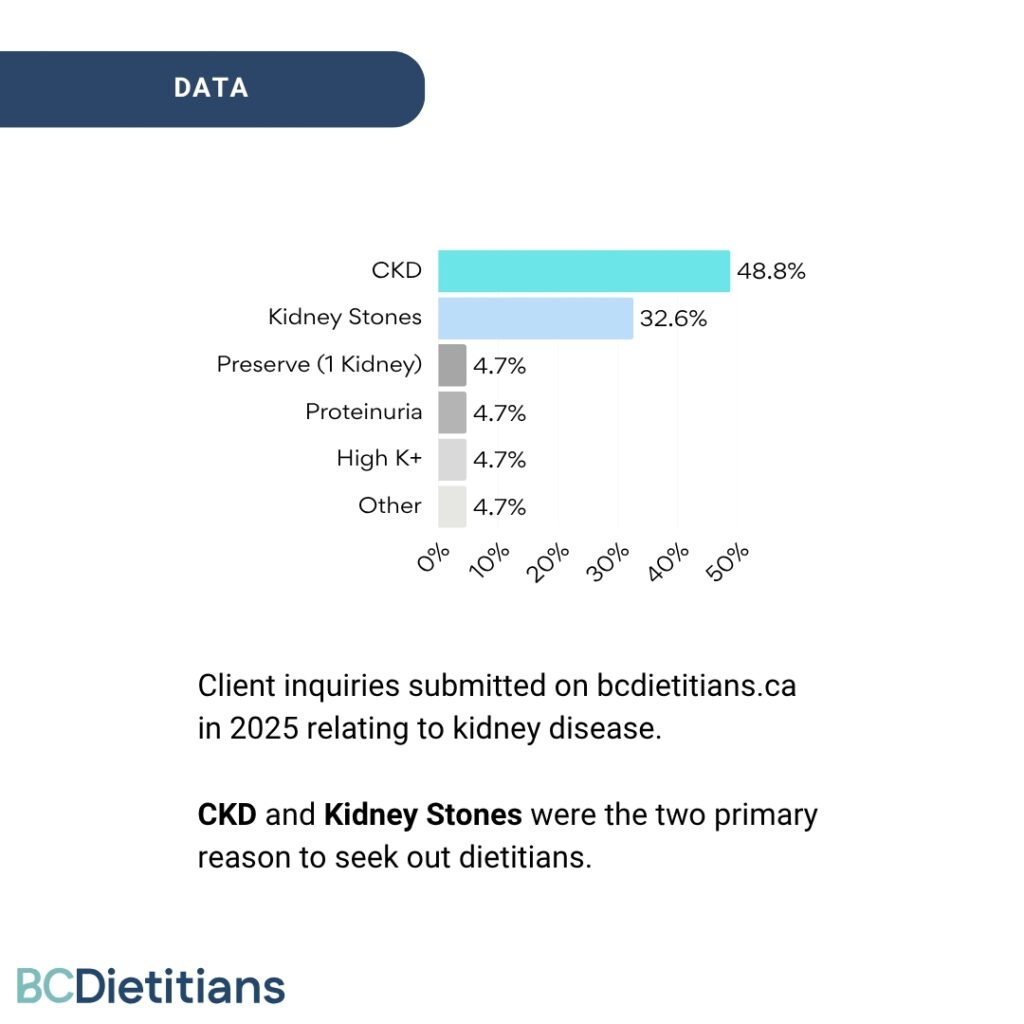
According to Kidney Foundation of Canada, about 12% of men and 6% of women will develop a kidney stone at some point in their lives and recurrence is common, with an estimated 15% chance in the first year and 50% within ten years.
Rates have been rising for decades, with Canadian data showing a 4.7% increase in kidney stone episodes between 2013 and 2018 alone.
This is a common, painful, largely preventable condition affecting millions of people across Canada and the number is climbing.
What Happens When You Have Kidney Stones
Here’s how it typically goes.
You pass a stone (or you don’t, which is its own adventure). You see your doctor. You get a diagnosis. You may eventually see a urologist, if you can wait a year, or three, depending on your circumstances.
And nobody mentions nutrition.
Not because it doesn’t matter. It matters enormously. Kidney stones are one of the most nutrition-responsive conditions in medicine.
Fluid intake, dietary oxalate, sodium, calcium, protein – all of it plays a role, and all of it can help reduce your risk of kidney stones.
The recurrence rate without intervention is high. With the right dietary changes, it drops significantly. But you don’t hear about prevention in the exam room. So you go home and Google it. Or ChatGPT it. Wherever you’re at on the internet search spectrum.
Some of what you’ll find is accurate. Some of it is outdated. Some of it will have you eliminating entire food groups based on a Reddit thread from 2011. The internet does not triage well.
The Simple Hack to Prevent Kidney Stones
Here’s something I see regularly in my practice that I want to name directly.
One of the central pillars of kidney stone prevention is hydration. Drink enough fluid, reduce concentration in the urine, reduce stone risk. Simple in theory.
Except — it isn’t always simple.
I work with a lot of perimenopausal and postmenopausal women. Many of them have spent years quietly managing urinary urgency, leakage, or frequency. They’ve adapted. They’ve quietly reduced their fluid intake to avoid being caught somewhere inconvenient or needing to get up to pee 10 times at night. They’ve just… dealt with it.
Now someone is telling them to drink significantly more fluid every day. And they’re trying. And they’re not meeting the target. And nobody is asking why.
If someone isn’t hitting their fluid goals, there’s a reason. Maybe it’s untreated genitourinary symptoms of menopause. Maybe it’s a demanding job with no bathroom access. Maybe it’s something else entirely.
The recommendation on its own is only useful if the person can actually follow it and figuring out why they can’t is part of the work.
Why Nutrition is an Afterthought
I’ve been a dietitian for over 17 years. I have a lot of theories about this. The short version: nutrition is chronically underfunded, poorly integrated into our medical system, and still widely treated as optional rather than a life-changing clinical intervention.
The result is that patients are left to piece it together themselves.
Some find good information. Many don’t. And the gap between “got a diagnosis” and “got actual support” is where stones recur, where confusion festers, and where people end up following advice that ranges from unhelpful to genuinely harmful.
If you’re already dealing with kidney stones and want personalized guidance, I offer virtual nutrition counselling across BC, Alberta and Ontario.
Book a free discovery call with me. Let’s figure out what’s actually going on and build from there.





Add a comment