
Many people will experience constipation at some point in their lives, whether it’s a short-term change in your bathroom routine or an ongoing, chronic issue. In fact, an estimated 9-20% of the global population is affected by chronic constipation per the World Gastroenterology Organization (WGO).
Given how common constipation is, it’s not surprising there are many remedies we frequently hear recommended by both professionals and the general public. The question is, which solutions actually work?
In this blog, we will cover the basics of constipation and simplify the most updated consensus on the best ways to treat it, particularly for those who experience it chronically.
What are the symptoms of constipation?
Every person has their own “normal” bathroom routine. Some people may have multiple bowel movements each day, while others may go every 2-3 days – both can be completely healthy!
Many definitions of constipation exist, but the main symptom of constipation is having bowel movements less often than what is normal for you, or less than 3 bowel movements per week.
Other symptoms can include having hard or difficult to pass stools, straining, bloating, and abdominal discomfort.
Common causes of constipation
Constipation can be caused by many different things, and often more than one factor at once!
Some of the common causes include:
- Low fluid and/or fibre intake – Our bodies need enough fluids to be absorbed into our colon to soften stool and help it move through the GI tract. On the other hand, we also need adequate fibre to pull that water into our stool and provide bulk.
- Low levels of physical activity – Being active helps promote bowel movements, so a sedentary lifestyle or having restricted movement due to illness or disability increases risk of constipation.
- Certain medications and/or supplements – Some medications, such as opioids, antidepressants and antacids, can cause acute or chronic constipation. Supplements such as iron supplements and excessive fibre supplements can also cause constipation.
- Changes in routine or travel – Disruptions to your regular routine, such as travelling or changing jobs, can impact your typical bowel habits.
- Stress – Feeling stressed or anxious can trigger a release of hormones that may slow down our digestive system.
- Pregnancy – Many changes that occur during pregnancy can cause constipation, including hormonal, lifestyle, and physical changes.
- Overuse of laxatives – While they may work in the short-term, using laxatives too frequently can cause reliance which can actually worsen constipation in the long-term.
What are the different types of constipation?
Acute constipation
Occasional disruptions to your bowel routine that occur suddenly is considered acute constipation. This is most often caused by the factors mentioned above. Thankfully, most cases resolve on their own or through small lifestyle changes.
Chronic constipation
Chronic constipation is a more complex condition that occurs frequently over a longer period of time. It can become a serious concern and significantly impact quality of life.
There are two diagnoses of chronic constipation – primary (functional) and secondary.
Primary constipation (functional constipation) is caused by physiologic issues rather than by a secondary source.
It is defined by the Rome IV Criteria as having two or more of the following symptoms for the past 3 months (with onset ≥6 months):
- Straining during more than ¼ (25%) of defecations
- Lumpy or hard stools (Bristol Stool Form Scale 1-2) more than ¼ (25%) of defecations
- Sensation of incomplete evacuation more than ¼ (25%) of defecations
- Sensation of anorectal obstruction/blockage more than ¼ (25%) of defecations
- Manual maneuvers to facilitate more than ¼ (25%) of defecations (e.g., digital evacuation, support of the pelvic floor)
- Fewer than three SBM per week
- Loose stools are rarely present without the use of laxatives
- Insufficient criteria for irritable bowel syndrome
Secondary constipation is caused by medications, such as opioids or iron supplements, or by medical conditions, such as colon cancer or depression.
When should I talk to my doctor about constipation?
More uncomfortable and concerning symptoms can arise when constipation is left ongoing and unresolved. This includes increased risk for hemorrhoids, small tears in the rectum, and blockages in your colon.
We recommend seeking advice from a healthcare provider if constipation is lasting several days beyond your normal pattern without resolution, or is accompanied by more severe symptoms such as bleeding, significant pain, and/or unexplained weight loss.
Managing Acute (Occasional) Constipation
Most people will experience an occasional bout of constipation, but simple lifestyle strategies are often enough to get things moving again.
Commonly recommended treatments include:
- Increasing dietary fibre, such as from whole grains, legumes, vegetables, fruits, nuts, and seeds.
- Drinking adequate amounts of fluids (preferably water!) to help soften stool and make it easier to pass.
- Eating prunes or making fruit lax, which contain fibre and sorbitol, a sugar that has a natural laxative effect.
- Getting regular exercise, such as walking, jogging or swimming, to help speed up gut motility.
While it may be tempting to take laxatives right away for quicker relief, they should not be your first step. Regular or long-term use of laxatives can actually worsen constipation over time by creating a dependency on them.
Managing Chronic Constipation
Managing chronic constipation can be complex.
Everybody is different and finding what works for you often involves quite a bit of trial and error. Many also feel frustrated and are unsure where to turn once they have exhausted the strategies commonly recommended for acute constipation.
In 2025, British Dietetic Association (BDA) published a paper which examined previous research on chronic constipation to set treatment guidelines based on which strategies are actually shown to be effective.
We will summarize the treatments reviewed by the BDA based on how effective they are at improving constipation by increasing stool frequency and/or softening stool consistency.
And if you don’t see one that works for you, don’t worry! Everyone is different, and we discuss some less researched methods later in the blog.
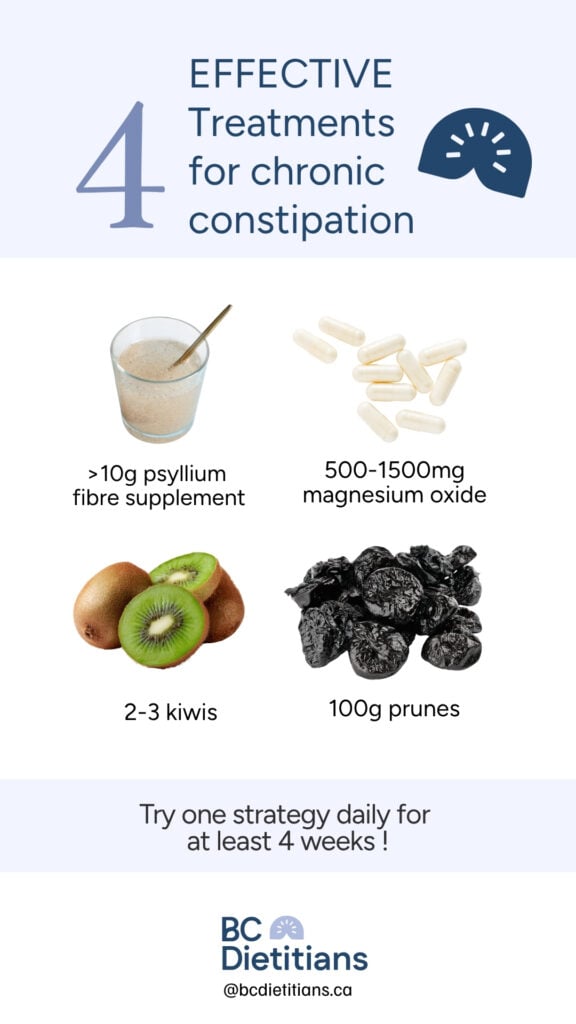
Below are the four strategies recommended in the BDA guidelines to treat chronic constipation based on evidence. It is suggested to try out one strategy daily for at least 4 weeks to determine if it works for you!
*As an Amazon Associate, we earn from qualifying purchases with the links listed in this article.*
1. Fibre Supplements:
Take fibre supplements 10+ grams per day to treat chronic constipation – be sure to add into your routine gradually to reach this dosage to avoid more digestive symptoms (ie. start with 2g daily then increase by 2g every few days day until you reach 10g per day) .
Also, make sure you drink enough fluids to avoid worsening constipation!
Studies have found fibre supplements to be effective at improving stool consistency and frequency. They also help in reducing straining severity while having a bowel movement.
Fibre supplements may be especially beneficial for people who feel they cannot reach the recommended amount of fibre per day, which is 25g for women and 38g for men.
Not all fibre-supplements are made equal.
The BDA found that psyllium supplements to be the most effective at managing constipation, and are mostly found in powder or capsule formats. Here are some options :
- Metamucil, Daily Psyllium Husk Powder Supplement, coarse texture 3.4g
- NOW Supplements, Whole Psyllium Husks 4g
- NOW Supplements, Psyllium Husk Caps 500 mg
- Psyllium Husk Powder, finely ground 3g
Inulin-type fructan supplements are not effective and may worsen gas. Many gummy fibre supplements are inulin-based.
Many people mistaken Metamucil gummies, capsules and powder are the same. However, only the powder and capsules are made with psyllium husk, NOT the gummies (made with inulin fibre – chicory and corn).
2. Magnesium oxide:
Magnesium oxide at doses of 0.5-1.5 grams (500-1500 mg) per day was found to improve constipation. Studies also show it improves quality of life and symptoms like bloating and discomfort.
Start at a lower dose (e.g., 500mg) then gradually increase as needed to minimize side effects.
Magnesium oxide helps draw more water into your colon which softens stool and increases the frequency of bowel movements.
A gentler form of magnesium is magnesium citrate, which has a milder laxative effect than magnesium oxide, it may still be effective for relieving constipation.
Magnesium bisglycinate is absorbed very efficiently and is less likely to have a laxative effect, making it a less suitable choice for constipation purposes.
3. Kiwis:
While it seems simple, kiwi fruits can actually be very beneficial for those with constipation!
BDA found that there was strong evidence behind having 2-3 kiwi fruits per day to be effective at relieving constipation.
Having kiwi may be preferred for those who experience side effects from fibre supplements and not to mention, they are a delicious snack!
Kiwifruit supplements were not shown to improve constipation in research, so be sure to opt for the whole fruits!
4. Prunes:
Yes, this classic remedy actually has evidence behind it!
Prunes have been found to be just as effective as psyllium fibre supplements at improving constipation at doses of 100g per day (~10-12 prunes).
Although they are super tasty, consider starting at a lower dose, such as with 2-3 prunes, and splitting doses (50g of prunes twice per day) to avoid excessive bloating and gas.
Strategies pending more research
As you may imagine, there are likely many other treatments for chronic constipation that have simply not been researched enough to provide evidenced-based recommendations.
Here we will discuss some of the most commonly recommended treatments that need more research:
High fibre diets
Eating more fibre seems like an obvious fix for constipation. However, the BDA found a surprising gap in research regarding using a high-fibre diet to manage chronic constipation.
Most studies to date have focused on fibre supplementation or individual fibre-rich foods.
There has yet to be any quality research on if eating a variety of fibre-rich whole foods that exceed standard daily recommendations can relieve chronic constipation.
Lower fibre diets tend to be associated with a higher risk of constipation, so increasing fibre intake to meet the recommended daily amounts (ie. 21-25g for women and 30-38g for men), can reduce the risk of constipation.
Research suggests that low-carbohydrate diets may increase the risk of constipation, potentially due to a decrease in fibre intake associated with these diets (less whole grain products).
While there has been a lot of research on fibre supplements, there is a lack of research on fibre above than recommended amounts.
If you aren’t sure you are reaching the daily recommended amounts to begin with and experience chronic constipation, check to see where you can boost fibre in your diet.
Good nutrition and bowel habits such as eating on a regular schedule, not skipping meals, and going to the bathroom as soon as you feel the urge to, may all help with constipation.
Increasing fluids
Drinking more water is likely to be effective for those whose acute constipation is caused by dehydration.
There isn’t enough research behind increasing your fluid intake beyond the recommended amounts (~2 litres) to relieve chronic constipation.
Probiotics and Synbiotics:
Probiotic strains that may help relieve chronic constipation but need more research include probiotics. B. Lactis and Bacillus coagulans.
For healthy adults with functional constipation, probiotics may help to alleviate some associated symptoms including bloating, cramping and gas, with a small improvement in stool frequency, and no improvement in stool consistency.
The Clinical Guide to Probiotic Products Available in Canada can be useful in choosing the appropriate product, dose, and formulation for a specific indication such as constipation.
Synbiotics, which are supplements that contain a mix of probiotics and prebiotics, have not been demonstrated to improve constipation, but are also not well researched yet!
While not well studied in the context of constipation, probiotics have been shown to improve gastrointestinal, immune, and metabolic health.
Probiotic foods, such as yogurt, kefir, and kimchi, have been shown to be beneficial for overall gut health, there hasn’t been enough research yet to support their use for chronic constipation.
Check out this blog to read more about probiotic foods and other foods that are beneficial for our overall gut health.
Fruits containing sorbitol
There is strong evidence supporting the use of prunes, which contain sorbitol, for treating constipation.
But what about other fruits that contain sorbitol, like pears, apples, and peaches?
Since sorbitol acts as a natural laxative, some people may find that other fruits containing sorbitol, such as pineapple, papaya, figs and pears, improve their bowel routine.
The laxative strength of prunes compared to fresh fruits (ie. plums) likely lies both in their volume.
Plums are very high in sorbitol compared to most other fruits. Drying plums into prunes decreases their volume and concentrates both their fibre and sorbitol content. This means that eating 100g of prunes is likely to have a stronger laxative effect than eating 100g of fresh plums.
Dates are another dried fruit sometimes recommended for constipation relief, although they have been studied far less than prunes. Prunes also contain significantly more sorbitol, which may make them more effective for constipation relief. Both dates and prunes are high in fibre, meaning they can both fit into a fibre-rich diet to prevent constipation.
Caffeine as a motility agent
Many people report that their morning cup of coffee has them quickly headed to the bathroom, but what about for people with chronic constipation?
Well, so far there hasn’t been any conclusive evidence supporting this strategy.
There is evidence that caffeine may influence gut motility, so hopefully we will eventually see more research on this possible treatment!
High doses of vitamin C
High doses of vitamin C have not only been proposed to prevent the common cold, but also to improve constipation.
This may be related to the fact that high doses of vitamin C possibly can cause diarrhea, however no studies have been conducted on this yet per the BDA.
Summary
Constipation is an extremely common condition with many possible causes. The treatment that works best is different for everyone.
Constipation along with other digestive symptoms can be especially frustrating and can significantly impact your quality of life.
Thankfully, there has been more and more research on effective treatments. The treatments most supported by research to improve chronic constipation are fibre supplements, magnesium oxide supplements, kiwifruit, and prunes. The use of sennosides is not recommended.
There are likely more effective strategies for chronic constipation that are just not well studied yet. This may include some commonly recommended strategies such as the use of probiotics, probiotic foods (like yogurt), high fibre diets, caffeine, and vitamin C.
If you struggle with constipation and/or other digestive issues and are looking for support, a gut health Dietitian may be able to help!
Blog contributor: Kiara Gaspari, RD
References
BDA: https://onlinelibrary.wiley.com/doi/10.1111/jhn.70133
Health Link: https://www.healthlinkbc.ca/healthlinkbc-files/managing-constipation-diet-adults
WGO: https://www.worldgastroenterology.org/UserFiles/file/guidelines/constipation-english-2025.pdf
AAFP: https://www.aafp.org/pubs/afp/issues/2011/0801/p299.html
PENNUTRITION : https://app.pennutrition.com/KnowledgePathway?kpid=3608&pqid=3609&pqcatid=146









Add a comment