
If dieting has never worked for you, it’s not because you didn’t try hard enough.
Most of the clients I work with are thoughtful, capable, self-aware, and deeply motivated. And yet food noise still feels louder than they want it to be.
Chasing weight loss as the only goal often does more harm than good for your health. Many women don’t want another diet, but they also don’t want to keep struggling with food, cravings, guilt, self-judgment, or that constant negotiation around food.
It usually isn’t about willpower – it’s about stepping out of the cycle of effort and reset that keeps your brain on high alert around food.
For the past three decades, I’ve helped men and women rebuild their relationship with food and establish a way of eating that works for them and that they can sustain.
As you read this post, I invite you to think about what changes when your goal shifts from fixing your eating to understanding it.

Caroline Klemens
The Moral Conflict Most People Carry Around Food
There’s a familiar thought I hear again and again:
“I don’t want a diet… but I also know that I need to change.”
You probably already know what balanced meals look like – proteins, carbs, fats, and portions. You may even follow it consistently for a few weeks.
And then something happens:
- A stressful day
- An unplanned dessert
- A weekend dinner out
And the thought appears:
“I’ve blown it.”
That thought triggers a cascade. You might restrict the next day, skip breakfast, promise to “be good” on Monday, or plan to start fresh next week.
Clean diet → slip → guilt and shame → restart.
This cycle keeps food loud and mentally exhausting.
Every restart reinforces the belief that you “fell off” and failed. Food stops being fuel and becomes something to monitor, manage, and control.
After working with men and women for 30 years, I can tell you that feeling stuck and out of control around food is rarely a discipline problem. It’s a natural body response to pressure and restrictions.
Why “Restarting” Your Diet Keeps You Stuck
Diets can work short term. What they don’t teach is how to eat in real life – when you’re stressed, tired, celebrating, grieving, or simply busy.
Restriction increases preoccupation.
When you label a food “off-limits”, your brain will interpret it as scarcity. Scarcity increases desire.
At the same time, under-eating can cause unstable blood sugar and dips in energy levels throughout the day. Skipping meals or cutting carbs to “make up” for overeating often leads to:
- Energy crashes
- Irritability
- Brain fog
- Strong cravings for sugary and high-fat foods
Dieting models can rely heavily on willpower. Dieting makes you override hunger cues and suppress cravings, disconnect you from your body’s signals. Over time, that erodes self-trust.
When weight inevitably returns (oftentimes to more than before), the distress, guilt, and shame can become even stronger. Food becomes something to control or fear.
The problem isn’t that you can’t stick to a plan.
The problem is a lack of awareness about the triggers to your cravings and emotional eating, and not having any alternative coping mechanisms besides food.
Cravings and Emotional Eating are Signals
Cravings are signals, not moral failures.
Sometimes they are natural physiological responses – if you skip meals or don’t eat enough earlier in the day, your blood sugar can dip and your body will seek for quick energy (=cravings!).
Other times, cravings reflect unmet emotional needs. Food can soothe stress, provide comfort, connection, and reward. Food is a very good coping mechanism for many of my clients, especially when the day is already too much to deal with. The problem is when food becomes your only coping mechanism.
When you begin to eat balanced meals and snacks regularly, stay nourished, and explore alternative coping mechanisms besides food, cravings will become less intense.
You gain power over food.
How I Help My Clients throughThe CALM Method & Neuro-Linguistic Programming (NLP)
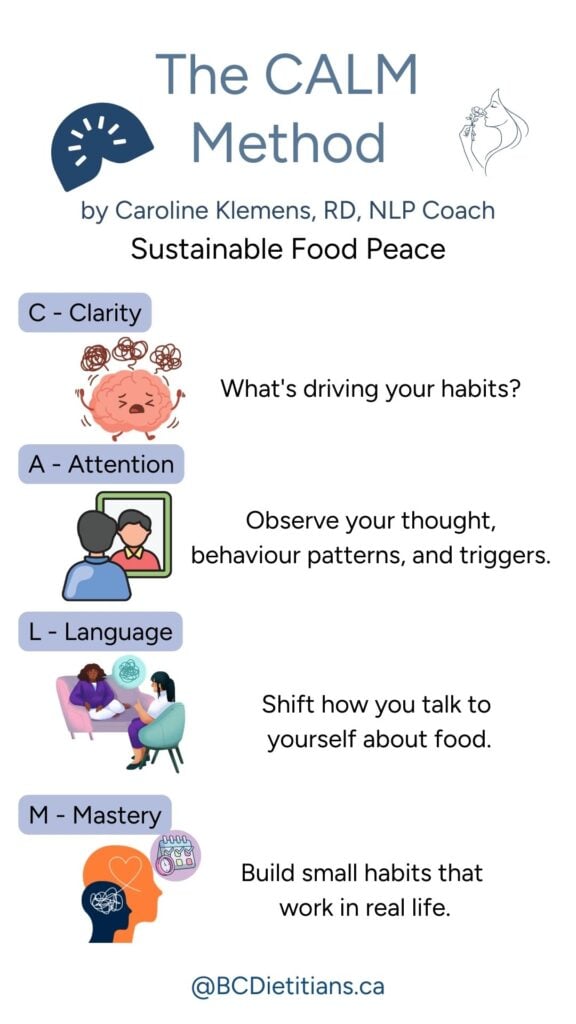
I use a “CALM method” to help men and women who are ready to stop dieting, to reconnect with their bodies and live in alignment with what actually supports their health – physically, mentally and emotionally.
Through my Calm Method, we focus on:
- Clarity – understanding what’s actually driving your habits, physiologically and emotionally
- Attention – noticing the thoughts and beliefs that trigger emotional responses like guilt
- Language – shifting the internal dialogue and releasing old food rules
- Mastery – building small, repeatable habits that work in real life
We focus on bite-size steps. Small, doable actions that build confidence instead of overwhelm.
We address self-sabotaging beliefs such as “I can’t trust myself around sugar” and emotional associations tied to specific foods.
For my clients who feel like they’ve failed every diet under the sun, or are fed up with dieting, this work is relieving.
Because we’re not asking you to try harder, but teaching yourself to respond differently.
As a master Neuro-Linguistic Programming (NLP) coach, I can help you uncover and gently reframe those stories. When you change the meaning you assign to a moment, your reaction can change.
Instead of restriction or compensation when you’re off track. We ask “What was my body actually asking for? Was it hunger? Stress? Habit? Social connection?”
Then ask yourself a supportive question -> “What would actually support me right now?”
Support might look like eating your next meal normally and being more present when eating, finding activities unrelated to food that bring you joy, or taking five minutes to decompress and reconnect with your body.
When mindset shifts, behavior changes.
Most clients notice mental shifts – better energy, reduce cravings, less food guilt – even within the first couple of weeks.
Physical changes take a bit longer, but they tend to last. We focus on building strong roots so that the results are sustainable, not a short term fix.
You Deserve Sustainable Food Peace
The shift that changes everything is moving away from restriction.
Sustainable food peace doesn’t mean you’ll never think about food. It means food no longer dominates your mental space.
Sustainable food peace looks like:
- Having an additional slice of bread when you still feel hungry, without debating whether you “earned” it,
- Eating regularly without negotiating with yourself
- Enjoying dessert at a dinner party and not replaying it in your mind on the way home
- Eating differently on different days – or not – in ways that make you feel good, without labelling one as “good’ and the other as “bad”
- Feeling calm on vacation
- Feeling proud of how you care for your body
When food peace is present, “off-limit” foods become choices. Food cravings will feel optional rather than out of control. Hunger and fullness cues feel clearer. Flexibility replaces the “all-or-nothing” or “perfect eating” mentality.
The biggest transformation is the mental shift – you are in control.
A Better Way to Take Care of Your Health
You don’t need another new year resolution.
You don’t need to try harder.
You don’t need to fix yourself.
You need more consistent nourishment, a calmer nervous system, a different internal dialogue, a better approach that fits in your life.
When you move away from fixing your eating, and towards understanding patterns and reframing your response, food becomes quieter. And through this you can create lasting change.
This isn’t about giving up, it’s about building something that lasts.
It’s about waking up to how capable your body is when supported, not punished, and to how much better life feels when you let go of food rules that rule your life.
If you’re done with diets and ready for a different approach, I invite you to book a free consultation. Whether you’re certain you want support or simply curious about what’s possible, we can start there.
You don’t have to do this alone, I’d love to support you no matter what stage of the journey you’re at.





Add a comment