
Fertility refers to the body’s capacity to conceive and sustain a healthy pregnancy, which can occur naturally or with medical support. Fertility is influenced by many factors, and every person’s journey looks different.
For many people, the path to pregnancy is not exactly “easy”. In Canada, up to 15% of couples experience infertility. Since July 2, 2025, eligible B.C. residents may receive up to $19,000 in one-time funding for a standard IVF cycle at participating clinics.
Whether you’re trying to conceive naturally, preparing for assisted treatment such as IVF, navigating a diagnosis like PCOS or endometriosis, or simply wanting to support your reproductive health, what you eat and your lifestyle can play an important role in preparing and supporting your body along the way.
As a dietitian that works closely with couples looking to improve fertility, I provide one-on-one support tailored to your lifestyle, diet history, medical background, and lab results.
Together, we focus on realistic nutrition and lifestyle changes that can meaningfully support egg health, sperm health, hormone balance, and overall wellbeing.
In this article, I’ll walk you through how nutrition supports fertility, common challenges, key nutrients for egg and sperm health, the role of lifestyle factors like stress and sleep, and how working with a fertility-focused dietitian can support both natural conception and assisted reproductive treatments.
- How Your Diet can Support Fertility
- Key Nutrients for Fertility
- Plant-Based Diets and Fertility
- Antioxidant-Rich Foods and Egg & Sperm Health
- How Can Nutrition Support Progesterone and Hormone Balance?
- Fertility Supplements to Consider
- Addressing Fertility Challenges through Nutrition
- Managing Weight for Fertility & Pregnancy
- How a Dietitian can Support Your Fertility and Perinatal Journey

Annie Tsang
How Your Diet can Support Fertility
Nutrition plays a foundational role in reproductive health. Adequate energy intake, balanced macronutrients, and key micronutrients support:
- Ovulation and menstrual regularity
- Hormone production and balance (including estrogen and progesterone)
- Egg and sperm quality
- Implantation and early pregnancy development
Nutrient deficiencies can negatively affect fertility outcomes, including ovulation, egg fertilization, sperm count and motility, and implantation. This is true even for individuals without a diagnosed fertility condition.
Nutrition also supports the luteal phase of the menstrual cycle by helping maintain stable blood sugar, healthy progesterone levels, and adequate blood flow to the uterus – all important for implantation and early pregnancy.
Fertility is not just a women’s health issue.
Men’s fertility is equally influenced by nutrition, lifestyle, inflammation, and oxidative stress. Diet plays a role in testosterone levels, sperm production, and DNA integrity.
Female infertility contributes to only 35% of overall infertility cases, 20% of cases are related to both women and men, 30% involve problems only on the part of men, whereas 15% of infertility cases remain unexplained.
Key Nutrients for Fertility
Nutrients not only provide energy, they also play bioactive roles that support reproductive function, reduce inflammation, and help regulate key processes like ovulation.
When preparing for pregnancy, I emphasize both micronutrients and macronutrients, as both are essential for hormonal health, cellular growth, and energy balance.
Micronutrient balance & Fertility
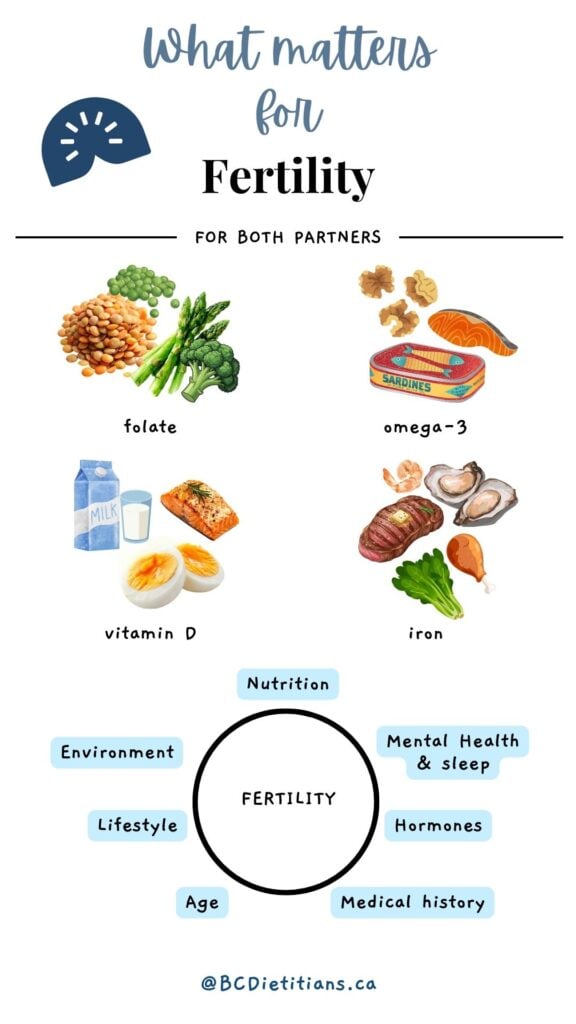
Folate (and Folic acid)
Folate (400mcg/day for women, and 400mcg/day for men) is critical for cell growth, DNA synthesis, and early embryo development, folic acid supplementation helps with neural tube development in the first weeks of pregnancy.
For all women who could become pregnant, Health Canada recommends supplementing with 400mcg of folic acid daily (in addition to folate from foods) to reduce the risk of neural tube defects. This is recommended because many pregnancies are unplanned.
Low folate status and elevated homocysteine levels have been associated with reduced egg quality and lower fertilization success. For those with MTHFR gene variations, folate form and absorption may require special consideration.
Iron
Iron (18mg/day for women and 8 mg/day for men) is a critical component of many enzymes and of hemoglobin – which supports oxygen delivery throughout the body. The recommended daily intake of iron further increases in pregnancy. Iron deficiency can impair ovulation and fertility.
Vitamin D
Vitamin D (600 IU/day for both women and for men) helps regulate reproductive hormones and supports ovarian and testicular function. Deficiency and suboptimal status is common and often identified through blood work. Low vitamin D status has been associated with an increased risk for infertility.
Macronutrient balance & Fertility
Eating patterns that focus on balance and variety (emphasizing whole grains, fruits, vegetables, healthy fats, and plant-based proteins) are associated with better fertility outcomes.
Whereas diets high in saturated fats, trans fats, highly processed carbohydrates, and excessive animal proteins may negatively impact fertility in both sexes.
Adequate intake of protein, carbohydrates, and fats is essential for hormone production, ovulation, and menstrual regularity:
- Protein supports satiety, tissue growth, and hormone synthesis
- Carbohydrates support energy availability and thyroid function
- Fats are necessary for hormone production and absorption of fat-soluble vitamins
Healthy dietary fats are key for hormone production and egg/sperm health.
Monounsaturated fatty acids (MUFAs) like omega-3s have been positively associated with fertility. They bind to key receptors in the body and reduce inflammation, improve blood flow to reproductive organs, support hormone signaling, and success in assisted reproductive techniques (ART).
For women, omega 3 (1.1g/day) helps regulate sex hormones like estrogen, support egg health, and support uterine lining thickness for implantation. For men, adequate omega-3 (1.6g/day) may improve sperm production, count, and motility.
Trans fatty acids (typically found in processed foods) increase insulin resistance and inflammation may be associated with infertility.
Proteins (0.8-1.1 g/kg body weight/day for women and for men) are essential for tissue repair, satiety, and hormone production (lean meat, fish, lentils, tofu). Plant-based proteins tend to support fertility, while excessive intakes of animal proteins may be linked to a higher risk of infertility.
Carbohydrates (130g/day for women and for men) provide steady energy and support hormone balance (whole grains, fruits, vegetables).
When it comes to carbohydrates, focusing on whole, fibre-rich, and low-glycemic index (GI) or glycemic load (GL) options can help stabilize blood sugar and support the body’s natural hormonal regulation. The recommended fibre intake for men aged 19-50 is 38g/day, while for women is 25g/day.
Antioxidant-Rich Foods and Egg & Sperm Health
Oxidative stress can negatively impact egg quality, sperm DNA, and implantation. Diets rich in antioxidants help protect reproductive cells and may be especially relevant for people with:
- Advanced maternal age
- Sperm abnormalities
- Recurrent implantation failure
- IVF and assisted conception
Foods rich in antioxidants include colorful fruits and vegetables, nuts, seeds, and omega-3-rich foods.
How Can Nutrition Support Progesterone and Hormone Balance?
A rise in progesterone helps prepare and thicken the uterine lining for implantation. Once conception occurs, progesterone helps prevent the uterine lining from shedding, preventing early pregnancy loss.
Foods that may support hormone balance (namely estrogen and progesterone) include cruciferous vegetables, seeds, nuts, salmon, and eggs. There isn’t a specific food that will directly increase progesterone.
While more research is needed, eating adequate foods with nutrients such as zinc, vitamin C, magnesium, vitamin B6 helps the body produce and maintain an optimal level of progesterone, and support hormone regulation.
- Chronic under-eating and/or low-carb intake can suppress ovulation → low progesterone
- Vitamin B6 supports luteal phase function and progesterone metabolism
- Magnesium supports nervous system regulation and may indirectly support hormone balance
- Zinc is important for ovulation and corpus luteum function which produces progesterone after ovulation
What matters most is supporting hormone balance including progesterone by consistently eating enough calories, including carbohydrates and healthy fats, and ensuring key nutrients like B6, magnesium, and zinc are adequate.
Plant-Based Diets and Fertility
Plant-based and vegetarian diets can support fertility when they are well-planned and nutritionally adequate.
Nutrients to monitor include protein, vitamin B12, iron, omega-3s, calcium, choline, and zinc.
Research shows that an anti-inflammatory, whole-food diet can help with fertility. That means focusing on vegetables, fruits, lean proteins, whole grains, nuts, and seeds while reducing ultra-processed foods and added sugars.
With the right planning, a vegetarian or plant-based diet is both safe and effective for conception and pregnancy.
Fertility Supplements to Consider
Diet quality and nutrition should be prioritized first in improving fertility. While fertility supplements are widely marketed, as a dietitian, I always advise a ‘food first’ approach.
Sometimes supplementation is recommended based on your food intake, lab results, and the perinatal stage you are in (e.g., preconception, pregnancy, postpartum).
Common supplements that I would discussed with my fertility clients include:
- Prenatal vitamin, with 0.4 mg folate or more (based on a risk assessment)
- Omega-3 fatty acids
- Vitamin D
- Choline
- Myo-Inositol & D-Chiro-Inositol (particularly for people with PCOS and TTC)
- CoQ10 (for egg and sperm quality, especially in relation to age-related declines in fertility)
Every supplement plan is personalized to ensure it fits your needs. It’s important to consult your dietitian or doctor before starting any new supplements.
Addressing Fertility Challenges through Nutrition
Many conditions that affect fertility are closely tied to nutrition and lifestyle. The approach must always be individualized – providing targeted strategies to manage symptoms and improve outcomes.
An experienced dietitian can provide nutrition perinatal support while navigating these underlying medical conditions to optimize fertility and health.
Optimizing chronic medical conditions prior to conception and throughout pregnancy can improve fertility and optimize parents and baby’s health.
Polycystic Ovary Syndrome (PCOS)
PCOS is one of the most common conditions I see in practice and can present fertility challenges. PCOS is often linked to insulin resistance and hormone imbalances.
Estrogen dominance (an imbalance where estrogen is high relative to progesterone) can be a result of the absence of ovulation due to excess androgens (“male hormones”), and can cause irregular period cycles.
Endometriosis
This hormone-dependent inflammatory pelvic condition is defined as the presence of endometrium-like tissues, outside the uterus. Endometrium is the layer inside the uterus that bleeds every month to make a period.
Symptoms may include pain with periods and non-menstrual pain (such as pelvic pain, pain with sex, and pain with bowel movement). Endometriosis may reduce chances of pregnancy, with chronic inflammation and hormonal imbalance being a few of the possible reasons.
Nutrition strategies will focus on reducing inflammation. Anti-inflammatory nutrition strategies, along with improvements in lifestyle habits (such as sleep hygiene), can help support symptom management and overall reproductive health.
Thyroid conditions
Both hypo- and hyperthyroidism (and any underlying causes like pituitary or autoimmune disorders) can affect fertility, and nutrition plays a supportive role alongside medical care.
Hypothyroidism, as indicated by a low release of thyroid hormones, affects ovulation and conception in women.
Hyperthyroidism, similarly, can cause irregular periods in women, and low sperm counts in men, amongst other effects that are still being studied. Both conditions affect sperm development.
Maternal age
The amount of good quality eggs that we have can definitely reduce with age. Nutrition can help support egg quality and reduce oxidative stress.
Managing Weight for Fertility & Pregnancy
Do you have to lose weight before trying to conceive?
A healthy body weight helps prepare your body for pregnancy. Lots of research for fertility chances were based on BMI, but there are many other meaningful indicators besides a number on the scale.
A healthy body composition supports conception. Too little or too much body fat can disrupt reproductive hormones and increase the risk of abnormal ovulation and complications in pregnancy.
We use a body composition scan in our Burnaby office for preconception to help you understand your body composition beyond the number on a scale. Note: we do not use the scan during pregnancy.

Weight gain during pregnancy
The recommended weight gain throughout pregnancy will depend on your pre-pregnancy weight, as well as whether you are carrying a single child or multiples. Most of the weight gain will happen in the 2nd and 3rd trimesters of the pregnancy.
Here’s the recommendation for weight gain throughout each trimester for singleton pregnancies, based on pre-pregnancy BMI:
- 1st trimester: 0.5 – 2kg (1.1 – 4.4 lbs)
- 2nd and 3rd trimester: 0.2 – 0.5kg (0.5 -1lb) per week
- Entire pregnancy: 5 – 18kg (11 – 40lbs) per week
It’s important to note that more weight gain is recommended for people with a lower or higher pre-pregnancy BMI may have slightly different goals.
- For example, people with a BMI of 18.5-24.9 are recommended to gain 0.4kg (1lb) per week during the 2nd and 3rd trimester, with a total weight gain of 11.5-16kg (25-35lb).
- People with a higher starting BMI of 25-29.9 are recommended to gain 0.3kg (0.6lb) per week during the 2nd and 3rd trimester, and 7-11.5kg (15-25lb) of total weight gain.
A steady increase in weight that aligns with recommendations is one of the few indicators of maternal health and proper fetal growth.
Tools like the pregnancy weight gain calculator from Health Canada can help you understand and set realistic, healthy goals.
Check out this 7-day prenatal meal plan for a easy-to-follow meal plan for what and how much to eat to support nutrition throughout a healthy pregnancy.
How a Dietitian can Support Your Fertility and Perinatal Journey
Nutrient-dense meals, consistent habits, and compassionate support can meaningfully support fertility and a healthy pregnancy, whether conception occurs naturally or with medical assistance.
Nutrition plays a powerful role in reproductive health, but you don’t have to navigate it alone. A pregnancy and fertility dietitian can provide evidence-based guidance tailored to your body, your goals, and your unique journey.
My role as a fertility and perinatal dietitian is to look at the full picture: your health history, lifestyle, diet, lab work, and fertility goals. From there, I can provide guidance that is realistic, evidence-based, and tailored to you.
Here are some ways I can support you on your fertility journey:
- Comprehensive assessment: A deep dive into your medical history, lab works, symptoms, diet, lifestyle, and fertility goals.
- Tailored nutrition guidance: It’s not always about strict meal plans. Whether through structured plans or flexible strategies, I help you choose foods that support fertility without unnecessary restrictions.
- The use of tools: Depending on your needs, I may use food tracking, symptom logs, lab markers, pregnancy weight calculator, or InBody body composition scan (preconception only) to monitor progress.
- Support for all paths to pregnancy: Whether you’re looking to conceive naturally or with assisted reproductive technologies (IUI, IVF), nutrition can make a meaningful difference.
- One-on-one education and ongoing support that go beyond food.
Fertility nutrition is about setting up for success and preparing your body for a healthy pregnancy and baby.








Add a comment