
Counselling skills are an important part of dietetic practice.
Private practice dietitians in particular regularly utilize basic counselling techniques, such as assessing readiness to change and motivational interviewing, to address their clients’ nutrition needs.
There is no health without mental health. Oftentimes, our clients are faced with complex mental health challenges on top of their nutrition challenges. Afterall, our eating habits, relationship with food and nutrition status are deeply intertwined with our emotions, culture and mental health status.
There are many situations when a counselling expert can help our clients navigate through these challenges alongside with a dietitian to improve eating and nutrition.
In this blog, we will discuss when dietitians should consider referring to mental health professionals / counsellors, and vice versa. We will also dive deeper into the various professional titles in BC who provide mental health support as it can be quite confusing to navigate qualified professionals!

Collaboration with Qualified Counsellors
Interprofessional collaboration and referrals among health care practitioners (HCPs) is a key component of safe and effective care.
Effective collaboration begins with an awareness of what is beyond one’s scope of practice and what other qualified HCPs can fill that gap to address our clients’ needs holistically. As a regulated health professional, we have a duty to provide recommendations and/or treatments within our scope and refer out for other areas beyond our scope.
The different types of counsellors in BC
You may be surprised to hear that the titles “counsellor”, “therapist”, and “psychotherapist” are not currently regulated in BC.
This means anyone in the province can call themselves a counsellor or a therapist regardless of their education, training and/or qualifications. Finding an experienced counsellor and navigating through the credentials may be confusing for clients.
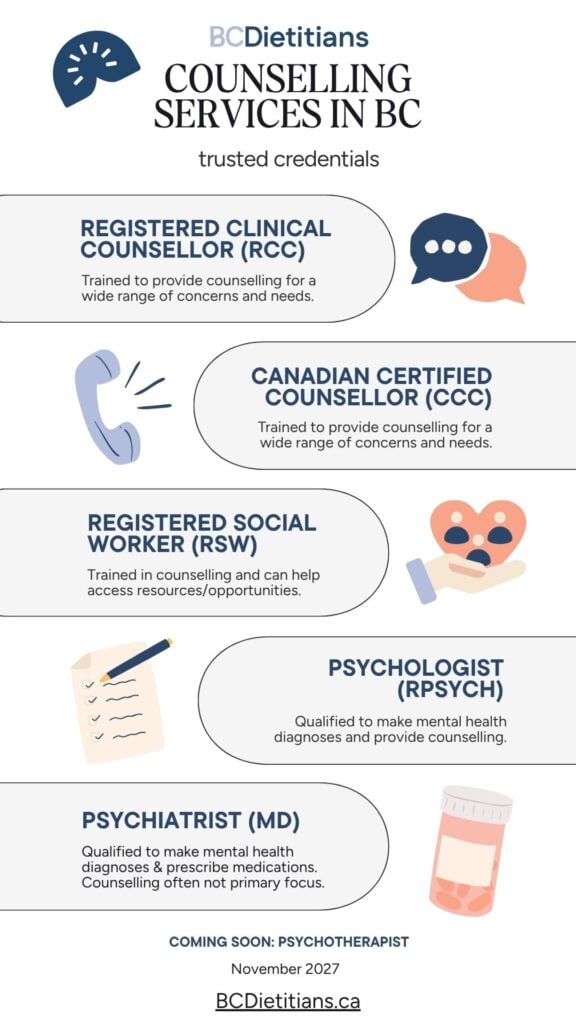
There are two commonly recognized titles in BC for general counselling services: Registered Clinical Counsellors (RCCs) and Canadian Certified Counsellors (CCCs). These titles are regulated by associations and have strict requirements for registrants and are often covered by extended health benefits.
We will go over the titles commonly considered for counselling services in BC.
Psychotherapist (RP)
Psychotherapist is a protected title in several other Canadian provinces, including Ontario, Quebec, New Brunswick, Nova Scotia, and Prince Edward Island.
In unregulated provinces/territories, including BC at this time, CCPA’s Canadian Certified Counsellor (CCC) demonstrates qualifications and certification criteria that parallel the requirements of the regulated titles of Psychotherapist and Counselling Therapist in regulated provinces.
Fortunately, starting November 29th, 2027, the title “psychotherapist” will officially become a protected title regulated by the College of Health and Care Professionals of British Columbia (CHCPBC), alongside dietitians, physical therapists, psychologists, and many more HCPs.
Registered Clinical Counsellor (RCC)
Designation issued by the BC Association of Clinical Counsellors (BCACC), a large professional association that requires applicants to meet strict academic and clinical competence, as well as professional requirements.
Specifically, RCC’s are required to have a master’s degree in counselling or psychotherapy, specific counselling course credits, and supervised clinical experience.
Canadian Certified Counsellor (CCC)
Designation with similar requirements as RCCs. The CCC title is issued by the Canadian Counselling and Psychotherapy Association (CCPA), and also requires a relevant master’s degree, education, and clinical experience.
Registered Social Worker (RSW)
Regulated profession that requires a bachelors or masters degree by the British Columbia College of Social Workers (BCCSW).
Along with counselling, social workers can help navigate life’s challenges, such as providing resources, finding new opportunities, etc. There are also Registered Clinical Social Workers (RCSW’s) who are qualified to diagnose and treat mental health disorders.
Psychologist (RPsych)
Regulated profession that requires a Phd degree by the CHCPBC. Unlike counsellors, psychologists are qualified to diagnose and treat mental health disorders using the DSM-5-TR.
Psychiatrists (MD)
Regulated medical doctors by the College of Physicians and Surgeons of BC (CPSBC) who specialize in diagnosis of mental health conditions and treatments including medications.
Psychiatrists may also provide psychotherapy or counselling interventions.
Other Counselling Titles
Naturally there are many more titles that individuals may practice under given that there is no officially recognized designation for those that provide counselling services yet.
- Registered Professional Counsellor (RPC) – Self-regulated by CPCA (Canadian Professional Counsellors Association). Applicants are required to hold a diploma in counselling (at minimum) and complete specified coursework and training hours.
- Registered Therapeutic Counsellor (RTC) – Self-regulated by ACCT (Association of Cooperative Counselling Therapists of Canada). There are education requirements for applicants; however the range of qualifications and expertise can vary widely.
Some practitioners with these and other titles may possess a comparable level of education to RCCs or CCCs, have completed shorter certification programs, or rely solely on life experience for their practice.
It is also possible for individuals to work without any formal title and simply refer to themselves as a “counsellor.”
Another unregulated title rising in popularity is “life coach”. As with counsellors, there are also no standardized qualifications or skills for life coaches. They typically work on goal-setting and life skills instead of working with those with mental health concerns.
When Should Dietitians Refer to Counsellors
While dietitians are trained to support behaviour change in regards to health and nutrition, many other areas may be better supported by a qualified mental health professional. Here are some common reasons a dietitian will refer or collaborate with a counsellor.
Ongoing mental health challenges:
- A client with ADHD who struggles following through on goals or developing habits.
- A client with anxiety on top of multiple food allergies, making it challenging for them to eat or experiment with new foods
- A client experiencing poor appetite and struggles to prepare regular meals due to depression
- A client with OCD who has rigid eating patterns or rituals around food and would like support managing intrusive thoughts
- A client recovering from an eating disorder who would benefit from concurrent psychological support as part of a collaborative team
Acute emotional or psychological concerns:
- A client who feels that they don’t have the capacity to make dietary changes due to unmanaged chronic stress
- A client experiencing significant grief that is affecting their daily functioning and self-care
- A client who discloses substance use concerns or unhealthy coping behaviours that may be affecting their nutrition and overall wellbeing
Specialized support needs:
- An athlete seeking nutrition support to improve their performance is also interested in improving their mental game or coping with pressure
- A client who recently started university is struggling with academic stress and newfound independence which impacts their ability to adequately manage their nutrition
- A client who discloses that conflicts within their family relationships or marriage are impacting their eating or self-care
When Counsellors Should Refer to Dietitians
Counsellors often aid clients in navigating complex emotional and behavioural challenges. However, these concerns often intersect with nutrition, making collaboration with dietitians an important part of comprehensive care.
Referrals to a dietitian are appropriate when clients have questions or concerns related to nutrition. Whether its general guidance on balanced eating to more specialized support for chronic conditions like diabetes or kidney disease, dietitians are best suited to provide nutrition therapy tailored to individual needs and goals.
Nutrition is often impacted by mental health. Many individuals struggling with anxiety or depression report changes in appetite, eating behaviours, and weight changes.
These can stem from the condition itself or from side effects of medications. In these cases, dietitians can help clients optimize their nutrition and develop realistic eating patterns that align with their care plan.
Some examples of clients who may benefit from seeing a dietititian.
Acute nutrition-related concerns or goals:
- A client who frequently skips meals or struggles to meet their nutrition needs due to an underlying depressive disorder
- A client interested in nutrition strategies and/or meal plans to improve their athletic performance and recovery
- A client interested in weight loss and/or improving body composition using realistic, balanced, and sustainable strategies
Chronic disease management:
- A client newly diagnosed with health conditions such as diabetes, kidney disease, or heart disease that require long-term dietary changes and specialized recommendations
- A client fighting cancer who is experiencing ongoing weight loss during treatment
- A client with IBS or IBD whose mental health is impacted by a fear of eating foods that trigger symptoms
Eating disorders and disordered eating:
- A client whose struggles with body image are tied to chronic yo-yo-dieting and weight fluctuation
- A client displaying signs of restrictive eating, binge eating, purging behaviours, compulsive exercise, or significant food-related anxiety
- A client in eating disorder recovery who needs support rebuilding trust with food, hunger-fullness cues, and regular eating patterns

Conclusion
We hope this blog helps bridge the gap between dietitians and counsellors and encourages stronger interdisciplinary collaboration.
Given the varying regulations across Canada regarding protected titles and scopes of practice, it’s important for HCPs to refer clients to qualified practitioners with the appropriate credentials.
And by understanding each profession’s unique role in supporting health and wellbeing, dietitians and counsellors are well suited to work together to provide safe and effective care for clients!









Add a comment